
MailChimp Review - Pros & Cons, Pricing, and Integrations




Updated March 10, 2023
Our team tests eCommerce apps and publishes reviews that are unbiased and not influenced by payments we receive from some of the app developers.

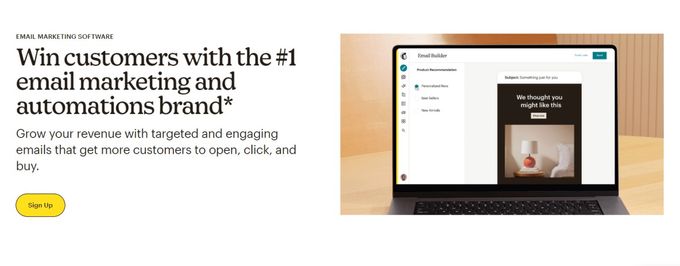
Mailchimp is a cloud-based email marketing service that allows businesses to create, send, and analyze email campaigns. The platform offers a range of features, including email templates, marketing automation, audience segmentation, and analytics.
According to a 2020 annual report, Mailchimp reported over 14-million current users that collectively send a mind-boggling 92 million emails a day, all of which are facilitated by their platform. But does this level of popularity mean that Mailchimp is the best option for you?
Well, that’s what we are going to explore here:
Pros
- Thorough reporting and analytics
- Easy-use-to use email and form templates
- Generous free plan
- User-friendly interface with drag-and-drop email builder
- Advanced automation features
- Advanced analytics and reporting
Cons
- Set up isn't always intuitive
- Mailchimp can suspend your account if they deem you've broken their Terms of Use
What Is MailChimp?
Mailchimp is a popular email marketing platform that enables businesses and individuals to create and send professional email campaigns to their subscribers. The platform provides a range of features to help users create effective email campaigns, including a drag-and-drop email editor, customizable templates, and automation tools.
Users can also manage their subscriber lists, track email performance, and integrate with other marketing tools and platforms. Mailchimp offers a variety of plans to accommodate businesses of different sizes and needs, and provides extensive support and resources to help users make the most of their email marketing efforts.

What is MailChimp Best for?
Mailchimp is recommended for users that:
- Are on the hunt for a newsletter service that integrates with a wide range of different tools.
- Run an e-commerce business and sell products through their email marketing campaigns. Mailchimp facilitates automated email marketing with integratable e-commerce abilities, making marketing and selling products super easy.
Mailchimp is not recommended for users that:
- Run affiliate sites or are affiliate marketers as Mailchimp prohibits affiliate marketing under its Terms of Use.
- Aren’t technically minded as the app can be painful to set up and their customer service can be rather limited.
Pricing
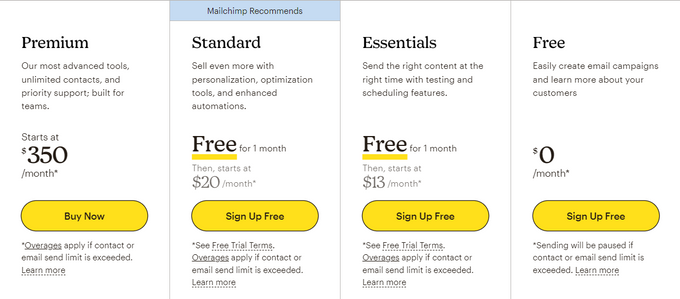
All of MailChimp's pricing plans are charged monthly, and they offer:
- Free plan - limited features, including 10,000 emails to 2,000 contacts/month.
- Essentials plan - costs $9.99 USD including 500-50,000 contacts/month.
- Standard plan - costs $14.99 USD including 500-100,0000 contacts/month.
- Premium plan - costs $299 USD including 10,000-200,000 contacts/month.
Integrations
Mailchimp’s integrations work with the most popular CMS platforms, plus a whole heap of other third-party applications, including:
- WordPress
- Squarespace
- Stripe
- Shopware
- Mixpanel
- Firebase
- Vimeo
- SurveyMonkey
- And a whole heap more
Features
Those that opt to use any of Mailchimp’s paid plans will have access to a whole heap of flexible and customizable email template designs. There’s a ton of choice and the templates can be customized using a drag and drop interface. The free plan does come with a few templates; although, they are a little limited in their customization and appear quite outdated.
- Email Templates: Mailchimp offers a variety of customizable email templates that allow businesses to create professional-looking emails without any coding skills.
- Audience Management: Mailchimp allows businesses to create and manage their email lists, segment them according to different criteria, and personalize emails for different audiences.
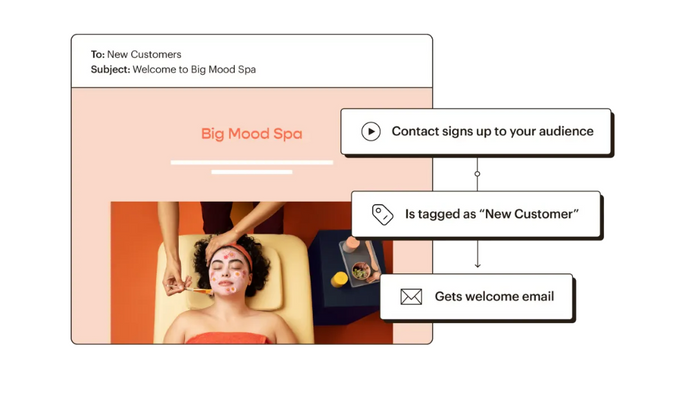
- Automation: Mailchimp's automation feature allows businesses to create email campaigns triggered by specific actions or events, such as welcoming new subscribers or sending abandoned cart reminders.
- Analytics: Mailchimp provides detailed analytics on email campaigns, including open rates, click-through rates, and engagement metrics, allowing businesses to track the success of their campaigns.
- Integrations: Mailchimp integrates with a range of third-party tools, including e-commerce platforms, social media platforms, and CRM software, allowing businesses to streamline their marketing activities across multiple channels.
- Mobile App: Mailchimp's mobile app allows businesses to manage their campaigns on the go, create and send emails, view analytics, and more.
Usability
Although Mailchimp may involve a bit of head-scratching to set up, once it is up and running the app’s ease of use quite good. Mailchimp’s clean interface, navigation, and tools are all fairly intuitive to use and simple to operate. Users can choose from pre-designed templates or create their own from scratch.
Additionally, Mailchimp offers analytics and reporting features to track the success of campaigns and identify areas for improvement. The platform also integrates with other tools such as social media, e-commerce, and CRM platforms to streamline marketing efforts. Overall, Mailchimp's usability makes it a popular choice for businesses of all sizes looking to streamline their email marketing efforts.
Support
Mailchimp’s customer support can feel rather lacking, particularly for those that are using the free plan. Although, those users that are using any of the paid plans will have access to 24/7 email, live chat, or phone support, depending on the plan of choice.
Why We Recommend It?
Mailchimp's intuitive drag-and-drop email builder makes it easy for even novice users to create visually appealing and effective email campaigns, while its advanced segmentation and personalization options allow for highly targeted and relevant messaging. The platform also offers seamless integration with Shopify, allowing for automatic syncing of customer data and purchase history.
The Bottom Line
Mailchimp is a great tool with a wide range of highly valuable integrated tools and features. And their free and premium plans are both generous and reasonably priced. Overall, we believe that Mailchimp is a top choice for Shopify store owners looking to improve their email marketing efforts and drive business growth.
MailChimp Review - Pros & Cons, Pricing, and Integrations


Recommended Reviews

Reviews.io Product Reviews for Shopify (2026) - Features & Pricing
Whether your online business offers customers products or services, it needs to stay competitive in today's online environments. One of the best ways to do this is with customer reviews. To help your business achieve this, Reviews.io has positioned itself in the market as a tool that will allow your online store to gather authentic customer feedback. Reviews.io does this by allowing the easy collection of online reviews, monitoring of your brand, and giving your customers the valuable opportunity of being heard. With all that said, is this marketing tool a good fit for you? Let’s take a look at how Reviews.io works and what value it can add to your online businesses. ProsAvoid negative publicity: Get genuine feedback from people who have actually used your services and products to avoid negative publicity and online complaints.Stay ahead of the curve: Combine customer feedback with other customer data to increase your ROI and maximize your marketing spend for greater business growth.Engage with your customers and grow your businessConsHigh cost for businesses that require full-featured plans: The monthly price tag may outprice some small businesses or startups. Best for Reviews.io is perfect for those businesses that are looking to quickly build their online reputation, boost customer loyalty, and social proof their products and services. Reviews.io Pricing 14-day trial for all plansEssential Plan: $45/monthSmall Business Plan: $89/monthGrowing Business Plan: $159/month Reviews.io's Possible Integrations One of the biggest advantages of Reviews.io is that it has an exhaustive list of integrations. The most popular of these integrations includes, but certainly isn't limited to,: Shopify and Shopify PlusBigCommerceFacebook for BusinessInstagramEKMGorgiasKlaviyoSlackSalesforcePlus a whole heap of customizable APIs Features of Reviews.io Reviews.io not only collects and analyzes customer feedback but also provides users with a ton of other great features as well. For instance, Reviews.io also uses artificial intelligence to analyze customer data and provide actionable insights to business owners. This functionality grants a number of benefits. For businesses, the platform improves customer service, marketing, and product development. For consumers, the platform helps them gain more knowledge about the products they purchase and the businesses they frequent. In order to gather and display customer feedback quickly, Reviews.io also allows users to easily import reviews from other platforms. This includes reviews from places like Google, Facebook, Yelp, Yell.com, Houzz, and Check-a-Trade. Usability of Reviews.io When it comes to Reviews.io’s usability, it’s kind of a mixed bag. For customers themselves, Reviews.io is comparable to other third-party apps such as Loox or Stamped.io - making obtaining customer feedback a super simple process. For business owners like yourself, Reviews.io can be a little less straightforward, particularly for those that are new to e-commerce apps for platforms like Shopify or BigCommerce. For example, although the application’s setup is generally considered a fairly easy process, some of the more advanced features can be a little trickier to get your head around. Reviews.io's Customer Support Reviews.io’s customer support is held in high esteem by most users. It is generally very responsive and helpful and can be reached through a variety of different ways, including 24/7 live chat, over the phone, or through the company’s online support center. The Bottom Line Customer satisfaction is important for any business, and this is only more paramount in the e-commerce space. Online shoppers rely on previous customers’ experiences and feedback to help them determine whether or not a company’s products and services are of high quality and are trustworthy. For these reasons, a marketing tool like Reviews.io is invaluable to your online business. With Reviews.io you can easily encourage customer feedback and read what your customers have to say about their experience with your business. This will not only socially proof your business but also help to gain that much-needed competitive edge over your online competitors.
Out-of-Stock Police: Best Inventory Management App for Shopify?
Sometimes, popular products fly off the virtual shelves of your Shopify store, leaving you with no inventory to serve new customers. When this happens, it’s important to ensure your customers aren’t actively trying to place orders for “out-of-stock” items. EGNITION's Out-of-Stock Police is a tool designed to assist store owners in optimizing and automating this process. The tool helps you to automatically push sold-out products to the bottom of your collections, so they’re less likely to get audience attention. Alternatively, you can hide your out-of-stock products completely until you refill your inventory. ProsFree package for up to 49 productsEasy-to-use interfaceCustomized sorting rulesAutomated workflows to save timeIncreased SEO performanceConsCan have a slight learning curveExpensive for the most advanced plans Out-of-Stock Police: Pricing Out-of-Stock Police offers a 7-day free trial to beginners, followed by a range of plans. There’s a free Bronze package, which supports stores with up to 49 products and 99 collections. This plan includes real-time automation, the option to hide or push your out-of-stock items down your collection lists, and tagging for out-of-stock products. You can also access 24/7 support and stock alerts. The paid plans essentially increase the number of products and collections you can manage, but they all include the same features. Options include: Customer Support Out-of-Stock Police promises 24/7 support to customers on every plan, including the free version. The company regularly releases new product updates and improvements, and guarantees fast responses if you’re having an issue with the app. However, the only real option for support is instant chat, so you won’t be able to call the team if you prefer to use the phone. Notably, the chat isn’t real-time, but someone is usually available to answer a question within the first hour or two after getting in touch. Who Is Out-of-Stock Police Best for? Virtually any business owner on Shopify could benefit from Out-of-Stock Police. All e-commerce leaders want to ensure their stores look up-to-date and engaging. That means it’s important to ensure your customers aren’t constantly facing “out-of-stock” notices whenever they click on a product page. Out-of-Stock Police helps to draw attention to the items you currently have available, so you’re more likely to generate conversions. It can also send you helpful automated alerts to let you know when you need to re-stock. Out-of-Stock Police: Features The focus of the Out-of-Stock Police app is to push your in-stock products into your customers' view, while moving out-of-stock items to the bottom of your collections. The tool integrates naturally with Shopify to help you organize your product portfolio. Key features include: Boosted SEO Out-of-Stock Police helps to boost your SEO by letting customers know when out-of-stock items will be returned to your site automatically. Rather than “hiding” pages, you can simply push them back in the collection queue, so they’re still indexed by Google. Automatic Collection Management The app will automatically push your out-of-stock items to the bottom of your collection as soon as your inventory status changes. This minimizes the amount of time you need to spend reworking your collections. Customization You can choose how you want to hide or move your out-of-stock items according to your inventory cycles. This could mean you set your product to be shown as “out of stock” for a certain number of days. If it doesn’t automatically come back in stock before the timer runs out, Out-of-Stock Police will continue to hide the product. Tagging You can assign specific tags to all out-of-stock items so you can use them in rules for smart collections, theme modifications, and other changes to your Shopify store. Automatic Republishing Business leaders can set the app to automatically re-publish hidden product pages when an item returns to “in-stock” status. This saves you the effort of manually removing and adding pages. Notifications You can get low-stock and out-of-stock alerts sent automatically to your email, complete with inventory data on a variant or product level. Easily export and download out-of-stock reports in seconds, so you can update your inventory. Out-of-Stock Police: Ease of Use Out-of-Stock Police is a relatively straightforward and convenient app. However, it might take a little time to get all of your automated workflows set up. You’ll need to define parameters like how long you want a page to be “pushed” to the bottom of your collection before the product is hidden. Despite this, the natural integration with Shopify and the convenient interface makes this tool a great choice for beginners. Plus, there’s plenty of customer support available if you have any issues. The Bottom Line: Is Out-of-Stock Police Worth It? Out-of-Stock Police is a convenient tool for companies struggling to keep track of their “out-of-stock” items on a Shopify store. It can help you to improve your SEO standing, increase your sales, and maintain the engagement of your target audience.
Shopify Single Sign-On (SSO): Improve Your Customers' Login Experience
In today's e-commerce landscape, conducting business on the cloud and using third-party services is the norm. As a result, users expect seamless and frictionless access from anywhere, anytime, and with any device. This is where single sign-on (SSO) login capabilities come into play. In this post, we will explore the benefits of Shopify Single Sign-On by miniOrange, an app that provides a solution to ensure an easy, secure, and efficient login to a Shopify store using a single set of credentials, all within minutes. Benefits of Shopify Single Sign-On Shopify sellers often have multiple e-commerce platforms in their business architecture. Using the Shopify Single Sign-On app, users can effortlessly log in to any of these platforms with a single set of login credentials. This eliminates the need for customers and employees to memorize different credentials for multiple applications, leading to increased staff productivity and user experience. Moreover, the app restricts users based on their behavior, like device location, time of access, the device used to access, etc., which helps prevent spammers from targeting and accessing your store. App Features & Integrations 1. Multiple Identity Providers (IDPs) The app supports multiple identity providers, including: Azure AD & Azure AD B2CAmazon CognitoOktaminiOrangePingOneGoogle Apps 2. Shopify Store as IDP Configure your Shopify Store as an identity provider and allow users to log in to any CMS platform or website using their Shopify credentials. Enable seamless single sign-on for multiple Shopify stores using one of them as the identity provider. 3. Attribute Mapping Attribute mapping allows the service provider to retrieve the necessary information from the identity provider and apply it to the user's account in the service provider. With Shopify Single Sign-On, you can assign user roles and map user attributes from the identity provider to the service provider (SP) during authentication. 4. Supports All Standard Authentication Protocols This includes the following: SAML 2.0OAuth 2.0OpenID ConnectJWTLDAPAPI authentication 5. Security Features The app has robust security features that protect against fraud and unauthorized access. It can be customized to meet the specific security needs of the business, and it complies with PCI DSS, GDPR, and HIPAA. The app also provides multi-factor authentication (MFA), customizable login widgets, and custom requirements. 6. Other Features Compatible with Shopify Headless Stores and Hydrogen FrameworkMobile SSO integrationRestricts users from using multiple devices to access the store during SSORestrict content on SSOEasy user management to delete & update used data in real timeOffers discounts based on customers' tags Pricing Plans Shopify Single Sign-On is available to both Shopify Plus and non-Plus businesses at affordable, industry-specific (B2B or B2C) price points. For B2C Businesses Features such as unlimited SSO user creation, account linking, a fully customizable login widget, and more are included in all four payment tiers. However, each plan has its own unique elements: Standard Plan ($89/month)1,000 unique usersBasic attribute mappingPremium Plan ($129/month) This plan offers all of the Standard Plan's features, as well as:3,000 unique usersAdvanced attribute mappingAuto redirect to IDP supportUser JWT after authenticationEnterprise Plan ($149/month) This plan offers all of the features of the previous plans, as well as:4,000 unique usersAdvanced attribute mapping, including metafieldsAuto update user profileDomain-based restrictionSession persists over 24 hoursAuto-taggingProfessional Plan (requires contacting the developers) This plan offers all of the previous plans' features, as well as:4,000+ unique usersCustom advanced attribute mappingFraud prevention based on IP, device, location, and time For B2B Businesses Most of the available features, from auto-tagging and account activation to domain-based restriction and customizable login widget, are included in all four pricing options. However, there are a few that are specific to each plan: Standard Plan ($89/month)100 unique usersBasic Attribute mappingPremium Plan ($219/month) This plan offers all of the Standard Plan's features, as well as:500 unique usersAdvanced attribute mappingMultiple IDP supportedUser JWT after authenticationEnterprise Plan ($299/month) This plan offers all of the features of the previous plans, as well as:1,000 unique usersAdvanced attribute mapping, including metafieldsRedirect endpoint and single logout endpoint (SLO)Session persists over 24 hoursProfessional Plan (requires contacting the developers) This plan offers all of the previous plans' features, as well as:1,000+ unique usersCustom advanced attribute mapping Support & Ease of Use Integrating Shopify Single Sign-On by miniOrange is a straightforward process that can be completed in minutes. The app has a dedicated 24/7 customer support team that responds to queries and troubleshooting. Alternatively, you can contact them at [email protected]. Final Verdict: Should You Use Shopify Single Sign-On? Shopify Single Sign-On by miniOrange is an app that provides a seamless and secure login solution for Shopify store owners and their customers. It eliminates the need for multiple credentials and restricts unauthorized access. It supports various authentication protocols, attribute mapping, and security features compliant with industry standards. The app is available at affordable price points for both B2B and B2C businesses, and its integration is easy with 24/7 customer support. If you're interested in trying the app, you can visit their website to learn more or start your 15-day free trial.